How to Measure Your Inseam
Affiliate disclosure: JeansForMen.com is reader-supported. This guide has no product picks — but when you buy through links on our roundups, we may earn a commission at no extra cost to you.
The short answer
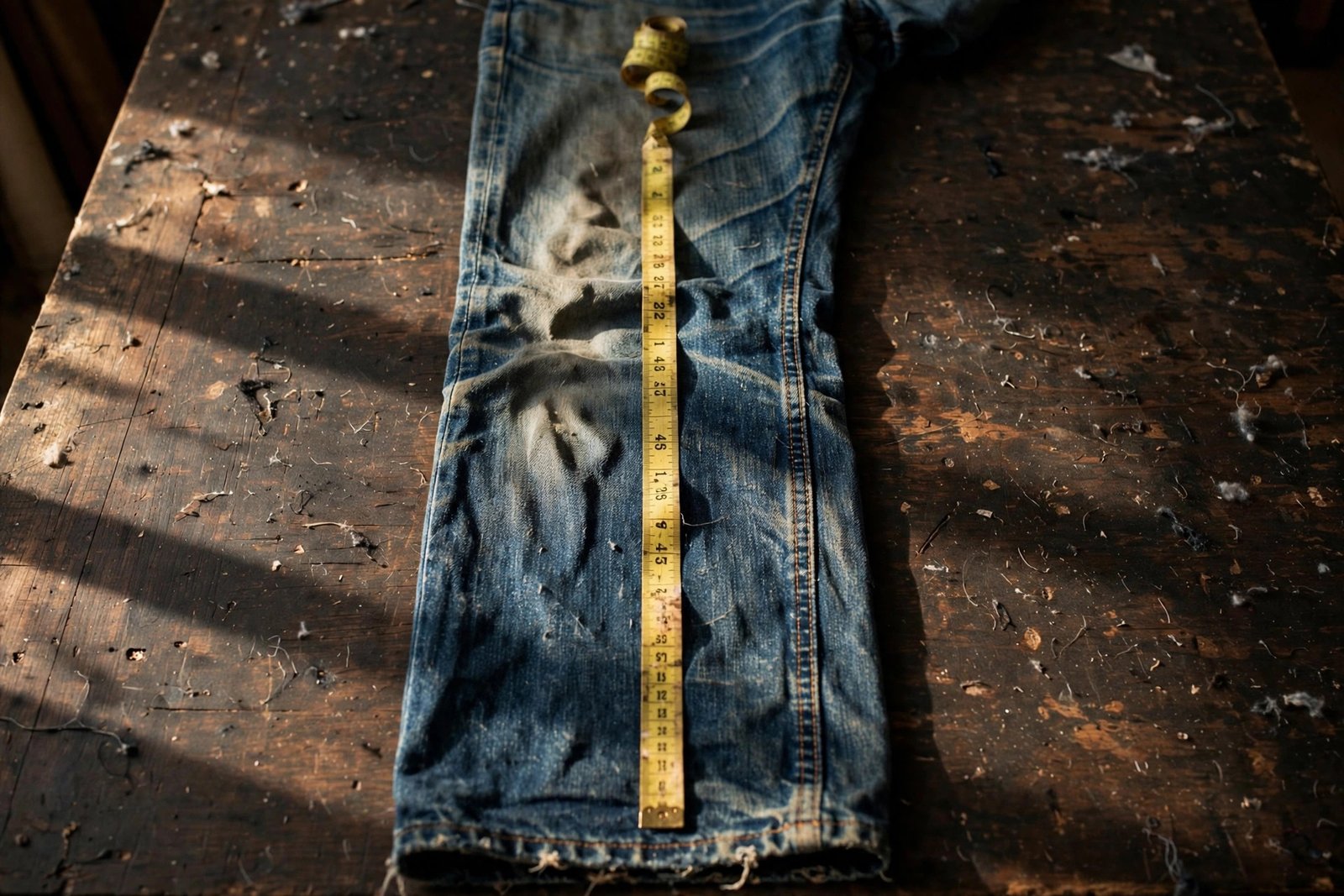
Your inseam is the distance from the crotch seam to the hem, measured along the inside of the leg. The fastest way to find yours: lay your best-fitting jeans flat, smooth out the wrinkles, and run a tape measure from the crotch seam straight down to the hem. That number — not the tag on a new pair — is the inseam you should shop for.
No jeans that fit well? (That’s probably why you’re here.) Measure your body instead: stand straight, measure from the top of your inner thigh to the floor, and add a little for your shoes and the break you want. Both methods, step by step, below.
Why tagged inseams lie
You’d think a 34″ inseam would measure 34 inches. Mostly it does — inseam tags are far more honest than waist tags. But “mostly” still leaves several ways to end up with jeans that don’t fit:
Vanity sizing hits the waist hardest. Fit consultancy Alvanon told NPR that the waist on a man’s pant generally measures 1.5 to 2 inches larger than the stated size — Esquire once taped a batch of tagged-36 trousers and found waists from 37 all the way to 41 inches. Inseam tags don’t get vanity-sized the same way, but the same loose manufacturing tolerance applies: small drift between two “identical” pairs is normal, not a defect.
Raw denim shrinks — sometimes by inches. Unsanforized (“shrink-to-fit”) denim can lose about 2 inches in the inseam on its first lukewarm soak, according to denim retailer Okayama Denim’s care guide. Sanforized or pre-washed denim is pre-shrunk at the mill and barely moves. So a tagged 36″ in raw unsanforized denim can become a 34″ after one wash. If you buy raw, size up in length, soak before you judge the fit, or stick to sanforized.
Rise changes where a tagged inseam lands. A 34″ inseam in a high-rise cut and a 34″ in a low-rise cut are the same length of fabric — but they sit on your body differently (more on this below). Compare inseams within the same rise family, or the numbers will mislead you.
Stretch forgives; rigid doesn’t. Stretch denim relaxes a little with wear. Rigid denim holds exactly what you bought — great if you measured right, punishing if you didn’t.
The takeaway: the tag is a starting rumor. Your tape measure is the truth. Five minutes now saves the order-return-reorder cycle that tall men know too well.
What you need
- A soft tailor’s tape measure (a few dollars anywhere; a metal construction tape works in a pinch but won’t follow the seam)
- Your best-fitting jeans — the pair whose length you’d clone if you could
- Optional: a helper for Method 2, and the shoes you actually wear with jeans
Method 1 — Measure your best-fitting jeans (easiest, most accurate)
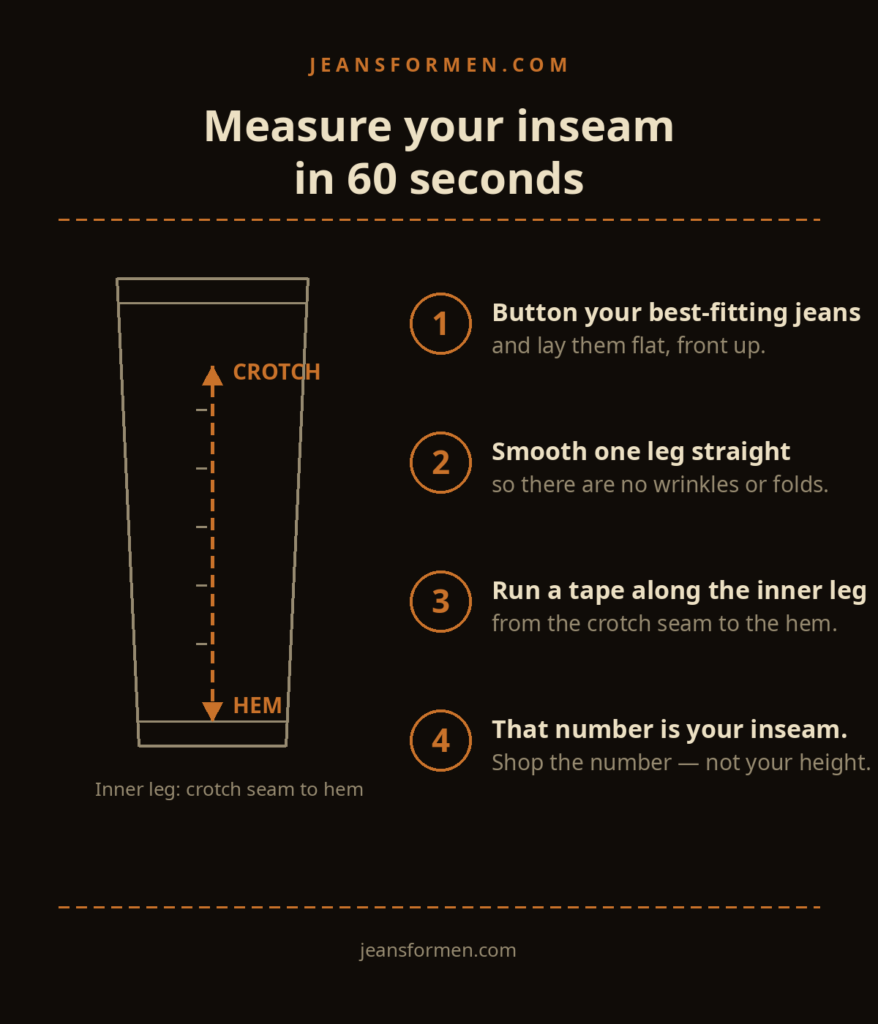
This is the method tailors and denim shops actually recommend, because it measures a real garment that already fits you instead of a body in an awkward pose. It captures your preferred break, your preferred rise, and your real leg — all at once.
- Button (or zip) the jeans and lay them flat on a bed or table, front side up. Smooth out wrinkles and folds along the leg — don’t stretch the fabric, just let it lie naturally.
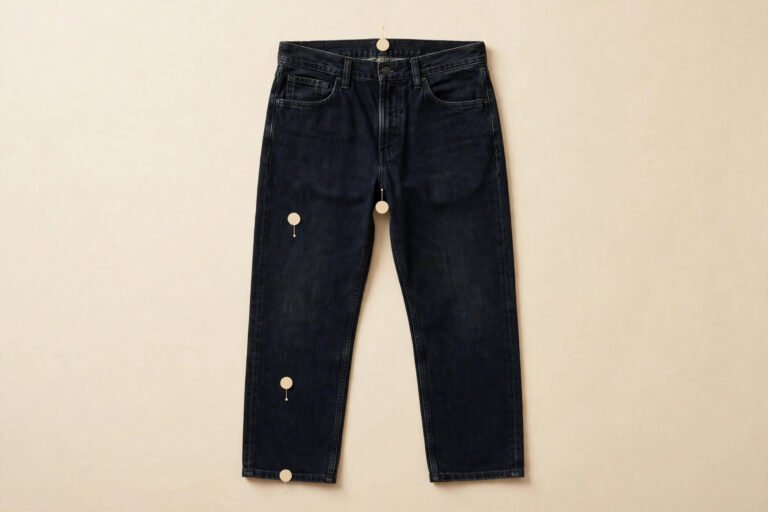
- Find the crotch seam — the point where the front and back panels meet between the legs. This is your zero point.
- Run the tape from the crotch seam down the inside of the leg, following the inseam to the very bottom of the hem. Read the number at the hem edge.
- Measure both legs. They should match; if they don’t, go with the longer one — it’s easier to hem a quarter inch off than to wish it existed.
- Write the number down — phone notes is fine. You’ll use it every time you shop.
One rule: measure the jeans you want to replicate. If you measure a slim low-rise pair but you’re shopping for a relaxed high-rise pair, the number won’t transfer cleanly. When in doubt, measure two pairs you like and average them.
Shortcut: no jeans you love? Cuff or pin a too-long pair to exactly where you want the hem to fall, then measure as above. You’re measuring your preference, not the garment.
Method 2 — Measure your body (no good jeans required)
Less precise than Method 1, but it works when you’re starting from scratch. A helper makes this dramatically easier — solo tape measurements up your own inner leg are where errors creep in.
- Stand straight against a wall, barefoot, feet a few inches apart. Stand naturally — don’t stretch up or slouch.
- Slide a hardcover book (spine up) between your legs and raise it until it’s snug against your crotch, level with the floor. This marks your body’s crotch point the way a tailor would.
- Mark the wall at the top edge of the book, step away, and measure from the floor to the mark. That’s your body inseam.
- No book? Have your helper run the tape from the top of your inner thigh straight down to the floor while you stand still. Take it twice and average — shifting your weight even slightly changes the reading.
Your body inseam is not your jean inseam. It’s the raw material. Your jean inseam = body inseam, plus or minus adjustments for shoes, break, rise, and whether you cuff. A barefoot measurement with a medium break and sneakers usually means adding about half an inch to an inch. If you live in boots, measure wearing the boots instead — simpler and more honest.
Height-to-inseam starting chart
Height is a rough proxy for leg length — two men at 6’4″ can need different inseams. Treat this as a starting point, then confirm with Method 1 or 2. The ranges match our tall-jean roundup, so the numbers line up with the shopping.
| Height | Start with this inseam |
|---|---|
| 6’0″–6’1″ | 32–34″ |
| 6’2″ | 34–36″ |
| 6’3″–6’5″ | 34–36″ (most land at 36″) |
| 6’6″–6’8″ | 36–38″ |
| 6’9″+ | 38–40″ |
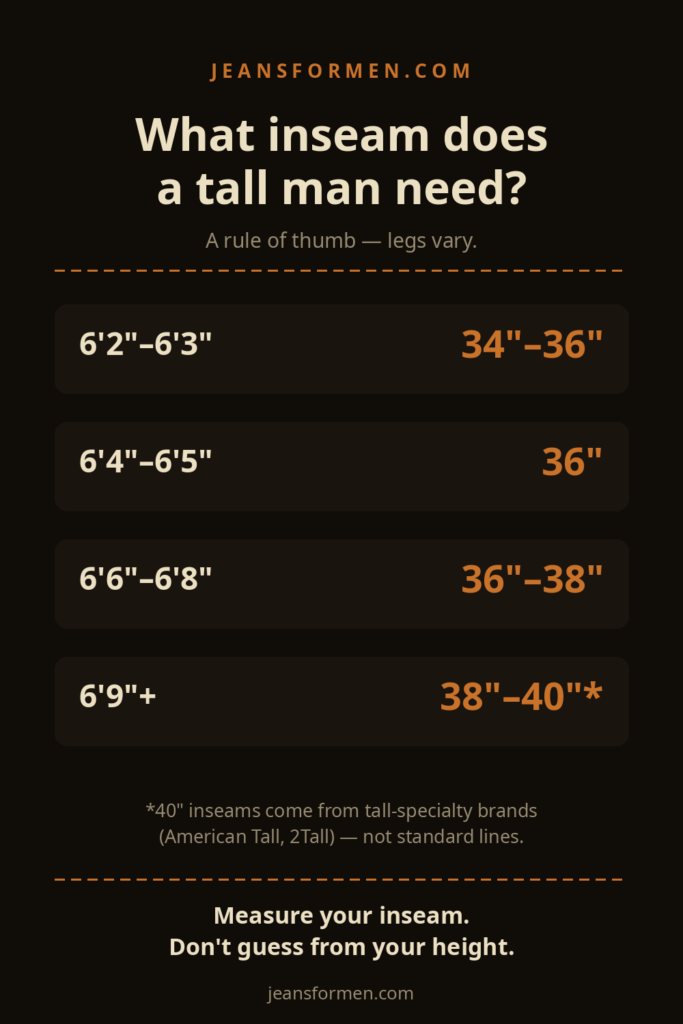
Long torso, shorter legs? Ignore your height and trust the tape. If your legs run short for your height, you’ll swim in the chart’s recommendation.
Know your number? Run it through our Find Your Fit tool — height, build, and inseam in, tailored starting points out. Ready to shop it? Here are the best jeans for tall men that actually stock 36″–40″ inseams.
What to do when you’re between sizes
Jeans come in whole-inch inseams; legs don’t. When you land on the half inch:
- Err long. A hem is the cheapest alteration a tailor does — quick, cheap, invisible. Nothing fixes a too-short jean. This is the single most important sentence in this guide.
- Order both inseams when returns are free. Most of the brands in our tall-men roundup offer free or easy returns. Ordering 36″ and 38″ in the same jean and sending one back settles it in one try and usually costs nothing.
- Don’t split the difference by sizing the waist. Buying a bigger waist to gain length has never worked — you get a saggy seat and the length still isn’t right. Buy your waist, buy your inseam, use the return policy.
How rise and shoes change the number you need
Rise eats length. Rise is the distance from the crotch seam to the waistband — it decides where the jeans sit. A high-rise jean worn at the natural waist puts its crotch seam higher on your body, so the same tagged inseam lands higher on the shoe than it would in a low-rise cut. Switching rises? Adjust about an inch in the corresponding direction for the same break.
Measure in the shoes you’ll actually wear. Heel height changes your effective leg length. Boots with a 1.5″ heel need more fabric than flat sneakers for the same look. If you split time between sneakers and boots, buy for the boots (longer) — a slight extra break in sneakers looks fine, but high-waters in boots look like a mistake.
Pick your break — it costs roughly half an inch per step. The “break” is the fold where the hem meets the shoe:
- No break: hem just kisses the top of the shoe. Clean, modern, shows ankle when you sit. Least forgiving — half an inch short and you’re in high-water territory.
- Slight break: a small fold at the front. The safest default for jeans.
- Medium break: a visible single fold. Classic, conservative, hides a multitude of sins.
- Full break: fabric pooling at the ankle. Works on wide legs; on slim jeans it just looks too long.
Each step up is roughly another half to full inch of fabric. For tall men buying online, slight-to-medium break is the smart target — it gives you margin against shrinkage and measuring error.
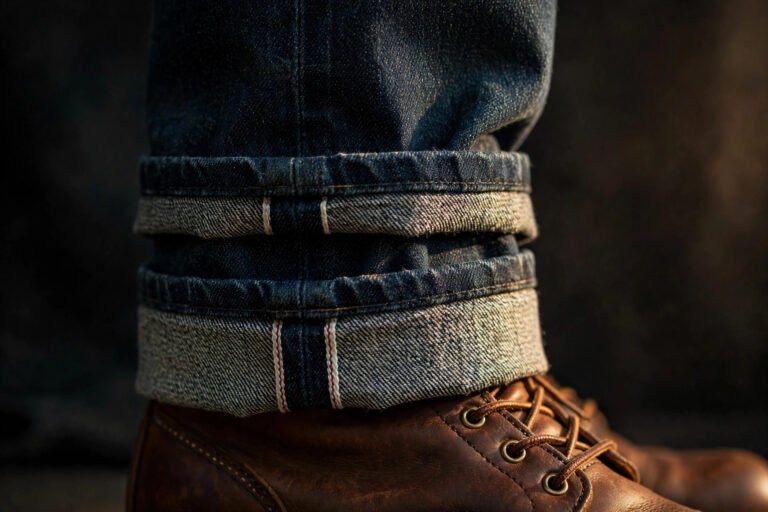
Cuffing? Add the cuff. A 1.5″ cuff needs about 1.5″ of extra inseam. Decide before you buy: a jean that’s perfect uncuffed will be too short the day you decide to roll it.
When to tailor vs. when to size up
Tailor (hem) when: the waist, seat, and thighs fit and only the length is long. The jean fits; it just needs finishing. Ask for the original hem to be reattached if you care about the faded edge; denim enthusiasts ask for a chainstitch hem to keep the roping effect as it fades.
Size up (or switch cuts) when: the waist gaps, the thighs pull, or the seat strains. That’s a fit problem, not a length problem, and no inseam number fixes it. Go back to the size chart — or better, to the tape measure.
Never when: the jeans are too short. There is no alteration that adds length. Return them.
FAQ
Can I measure my inseam without a tape measure?
Yes, with a workaround: mark the length with a non-stretch cord or shoelace, then measure the cord against a ruler. It works, but a soft tailor’s tape costs a few dollars and removes two chances to introduce error. Buy the tape.
Why do two pairs of “34 inseam” jeans fit different lengths?
Four usual suspects: manufacturing tolerance (small drift is normal), different rises (a 34″ in high-rise lands shorter on the shoe than a 34″ in low-rise), different states of shrink (a pre-washed 34″ and a raw unsanforized 34″ are different garments after one wash), and stretch (stretch denim relaxes with wear; rigid doesn’t). This is exactly why Method 1 — measuring jeans you already like — beats trusting tags.
Should I measure with shoes on or off?
For the body method, barefoot gives the cleanest baseline — then add roughly half an inch to an inch for sneakers and a medium break. But the honest shortcut: do it wearing the shoes you’ll wear with the jeans most. One less conversion, one less error.
I’m tall but my legs are average — does the height chart still apply?
No. Height is a proxy; leg length is the thing. Two men at 6’4″ can need a 34″ and a 37″. If your height comes from your torso, ignore the chart row for your height and trust Method 1 or 2. The chart gets you in the neighborhood; the tape gets you home.
Last verified: September 2026. We re-check our guides quarterly. Found something we got wrong? Contact us

One Comment
Comments are closed.