How to Cuff and Hem Jeans (And When to Do Each) — 2026
Affiliate disclosure: JeansForMen.com is reader-supported. When you buy through links on this page, we may earn a commission at no extra cost to you. Full disclosure →
The short answer
Cuff when the jeans are 1–3″ too long and you like the look — it’s free, reversible, and adds style. Hem when they’re more than ~3″ too long, when you never want to think about it again, or when cuffs would look sloppy (dressier settings, wide legs). A tailor hemming commonly costs $14–$25; original-hem or chainstitch specialty work runs $25–$40+. And the rule that matters most: never hem unwashed raw denim before its first wash — it will shrink past the hem.
Buying jeans to cuff? A cuff eats 1–2″ of inseam — buy accordingly. Our Find Your Fit tool factors it in, and the best jeans for tall men roundup covers which brands stock the extra length worth cuffing.
What you’ll need
- The jeans, obviously — washed at least once if they’re raw/unwashed denim
- A mirror (full-length beats a phone camera for judging break)
- The shoes you’ll wear them with most
- For hemming: a local tailor or denim specialty shop, and $14–$40 depending on the job
How to cuff jeans: 3 methods
Method 1: The single cuff (the default)
Fold the hem up once, about 1″ wide, all the way around. Smooth it flat so the fold sits even — lumpy cuffs look accidental.
- Eats: ~1″ of inseam
- Best on: slim and straight jeans; the cleanest everyday cuff
- Best with: sneakers, casual boots, anything low-key
This is the workhorse. If you only learn one cuff, learn this one. On a 34″ inseam it wears like a 33″ — which is exactly why tall men with slightly-long jeans should start here before paying a tailor.
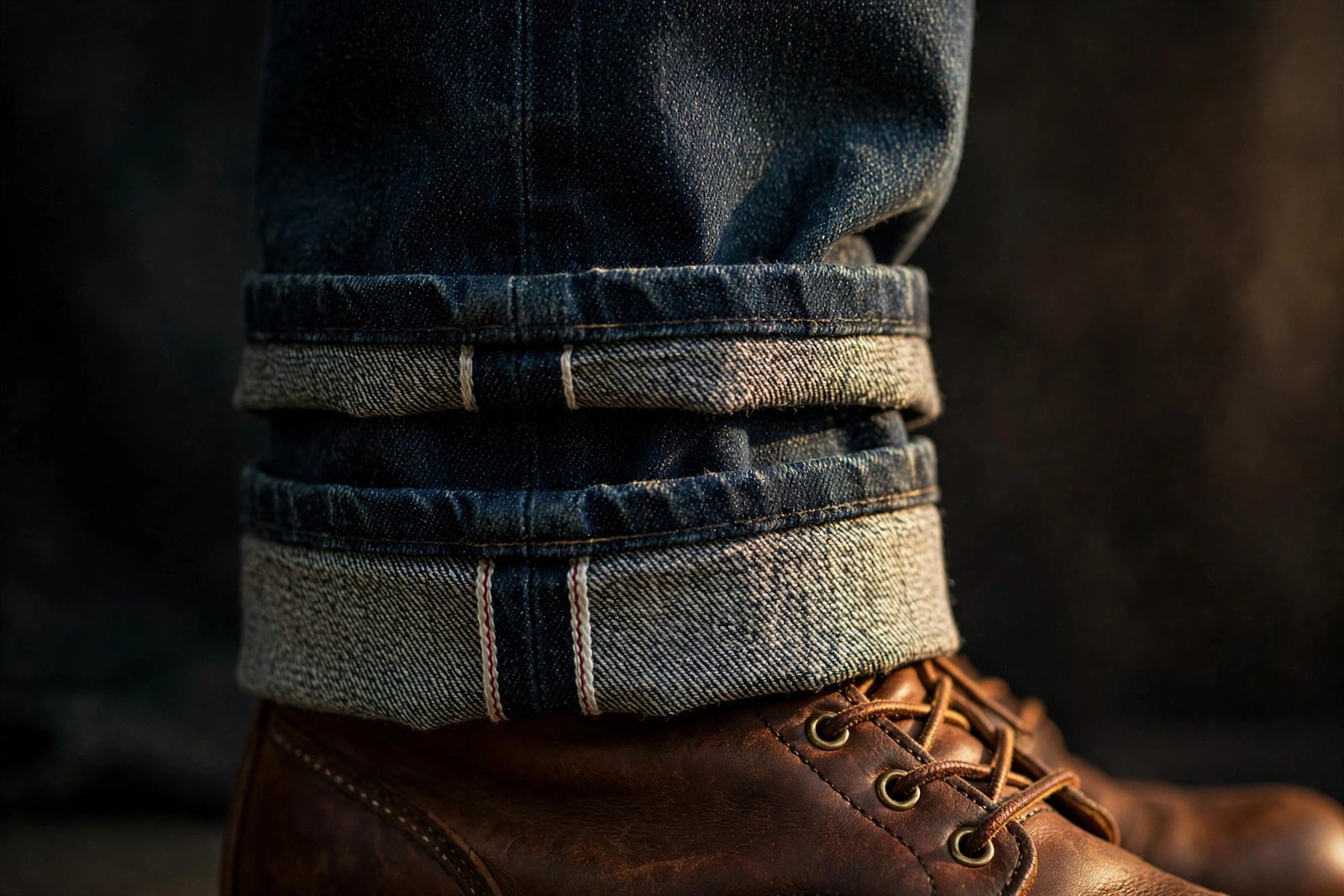
Method 2: The double cuff (the statement)
Fold once (~1″), then fold again (~2″) over the first fold. The result is a wider, heavier cuff — roughly 2″ tall — that shows off the inside of the denim.
- Eats: ~3–4″ of inseam total
- Best on: straight and relaxed jeans with enough fabric to fold twice without bulk; selvedge denim (the white-and-colored edge looks great here)
- Best with: boots, chunky footwear — heavier cuff wants heavier shoes
The double cuff consumes serious length, so it only works on inseams of 34″+ for most men — on a 32″ inseam you’ll be showing ankle. It’s also the least reversible-looking option day to day; fine, that’s the point.
Method 3: The pinroll (the taper hack)
Pinch the excess fabric at the inside of the ankle, fold it flat against your leg, then roll the hem up twice over the pinched fold to lock it in. This narrows a wide leg opening without a tailor.
- Eats: ~2–3″ of inseam
- Best on: straight or relaxed jeans you want to wear with low-profile sneakers
- Best with: minimal sneakers — the pinroll’s whole job is a clean ankle over slim shoes
The pinroll is a styling trick, not a fit fix. If the jeans are 4″ too long, no pinroll saves them — hem them.
How to hem jeans at a tailor
Cuffs are reversible. Hems are permanent — which is the point. Here’s how to get it right the first time.
Step 1: Decide the length in the shoes
Wear the jeans with the shoes you’ll actually pair them with, and pin or mark where you want the hem to land. Heel height changes everything — mark in boots if you wear boots. A tailor can only work with the mark you give them.
Step 2: Wash first if they’re raw
This is the expensive-mistake step. Unwashed (raw) denim shrinks on its first wash — sanforized denim up to ~5%, unsanforized 10% or more. Samurai Jeans’ own hemming service tells customers to hem after the first wash, or they add a 6–8 cm (~2.4–3.1″) shrinkage buffer. If your jeans are pre-washed or stretch denim (everything most men buy), hem away — the shrinking already happened at the factory.
Step 3: Tell the tailor exactly what you want
Walk in with this sentence: “Hem to [your mark], keep the original hem if possible.” Two things worth knowing:
- Original-hem hemming (also called European hem) cuts above the existing hem and reattaches it, preserving the factory-faded edge. Costs more ($15–$40+), worth it on jeans with a nicely worn hem.
- Chainstitch vs. lockstitch: most local tailors hem with a lockstitch — stronger, won’t unravel, perfectly fine. Denim purists prefer a chainstitch hem (the vintage Union Special machine stitch) because it produces the puckered “roping” fade around the hem as it wears. Chainstitching needs a specialty machine; denim shops charge roughly $25–$30 for it. For 95% of jeans, a good lockstitch hem is indistinguishable in daily wear.
Step 4: Expect to pay $14–$25
Ordinary jeans hemming at a local tailor commonly runs $14–$25 (2026 alteration price sheets cluster here). Original-hem or chainstitch specialty work runs $25–$40+. Quotes above the common range may reflect local labor costs, rush service, or more involved construction, so ask what the price includes.
Step 5: Try them on before you leave
Walk, sit, check the break in the mirror. A hem that’s perfect standing can ride up sitting — you want a slight break standing so it doesn’t go high-water the moment you sit. Fixing it on the spot is free; coming back isn’t always.
Cuff vs. hem: the decision
| Cuff | Hem | |
|---|---|---|
| Cost | Free | $14–$25 (up to $40+ specialty) |
| Reversible | Yes — unroll and it’s gone | No — permanent |
| Length it fixes | 1–3″ too long | 3″+ too long |
| Best for | Casual looks, selvedge, in-between lengths | Clean permanent length, dressier settings, wide legs |
| Tall-man use | Fills the gap when a brand skips your exact inseam | The fallback when nothing comes long enough to cuff |
The tall-man rule: if a jean comes in 34″ and 36″ and you need 35″, buy the 36″ and cuff it — don’t buy the 34″ and hope. Nothing fixes a too-short jean. A cuff is a style choice; a too-short hem is a mistake.
When to do neither: if the jeans are more than ~4″ too long, the proportions are wrong for hemming (the taper/knee placement lands in the wrong spot). Return them and size the inseam properly — see our inseam measuring guide.
3 mistakes that ruin good jeans
Hemming raw denim before washing. Covered above, worth repeating because it’s the most expensive mistake here: the hem ends up 1–3″ short after the first wash, and there’s no undo.
Cuffing to fix a bad fit. A cuff fixes length, not thighs, not waist, not seat. If the jeans pull or sag, the cuff is camouflage — fix the fit first (athletic builds and big & tall guides).
The too-wide double cuff on slim jeans. A 2″+ double cuff on skinny jeans looks like a denim bracelet. Match the cuff weight to the leg: slim legs get single cuffs, straight/relaxed legs can carry doubles.
FAQ
Should I cuff or hem my jeans?
Cuff if they’re 1–3″ too long and you like the look — it’s free and reversible. Hem if they’re 3″+ too long or you want a permanent, clean length. If they’re 4″+ too long, return them; the proportions won’t survive that much hemming.
How much does it cost to hem jeans?
Ordinary hemming at a local tailor commonly runs $14–$25. Keeping the original hem or getting a chainstitch hem at a denim specialty shop runs $25–$40+.
What is chainstitch hemming, and is it worth it?
Chainstitch is the vintage machine stitch (a looping continuous thread) that produces the puckered “roping” fade around the hem as raw denim wears. A standard lockstitch is stronger and won’t unravel, and looks identical in daily wear on most jeans. Worth it for raw-denim enthusiasts; unnecessary for everyday pairs.
Do I need to wash raw denim before hemming?
Yes. Unwashed denim shrinks on its first wash — up to ~5% if sanforized, 10%+ if not. Hem after the first wash, or have the tailor add a shrinkage buffer.
How much inseam does a cuff use?
Roughly: a single cuff eats 1–2″, a double cuff 3–4″. So a 34″ inseam with a 2″ cuff wears like a 32″. Buy the inseam that covers your needed length plus the cuff.
Last verified: September 2026. We re-check our guides quarterly. Found something we got wrong? Contact us →